
LESSON DESCRIPTION
This video explains the capacitor, one of the most common components found on laptop and desktop motherboards. A capacitor temporarily stores electrical energy as an electric charge and is widely used for voltage smoothing, filtering, decoupling, and noise reduction in both AC and DC circuits.
• Basic Operation: Learn how a capacitor stores charge using two conductive plates separated by an insulating material called a dielectric, then releases its stored energy into the circuit during discharge.
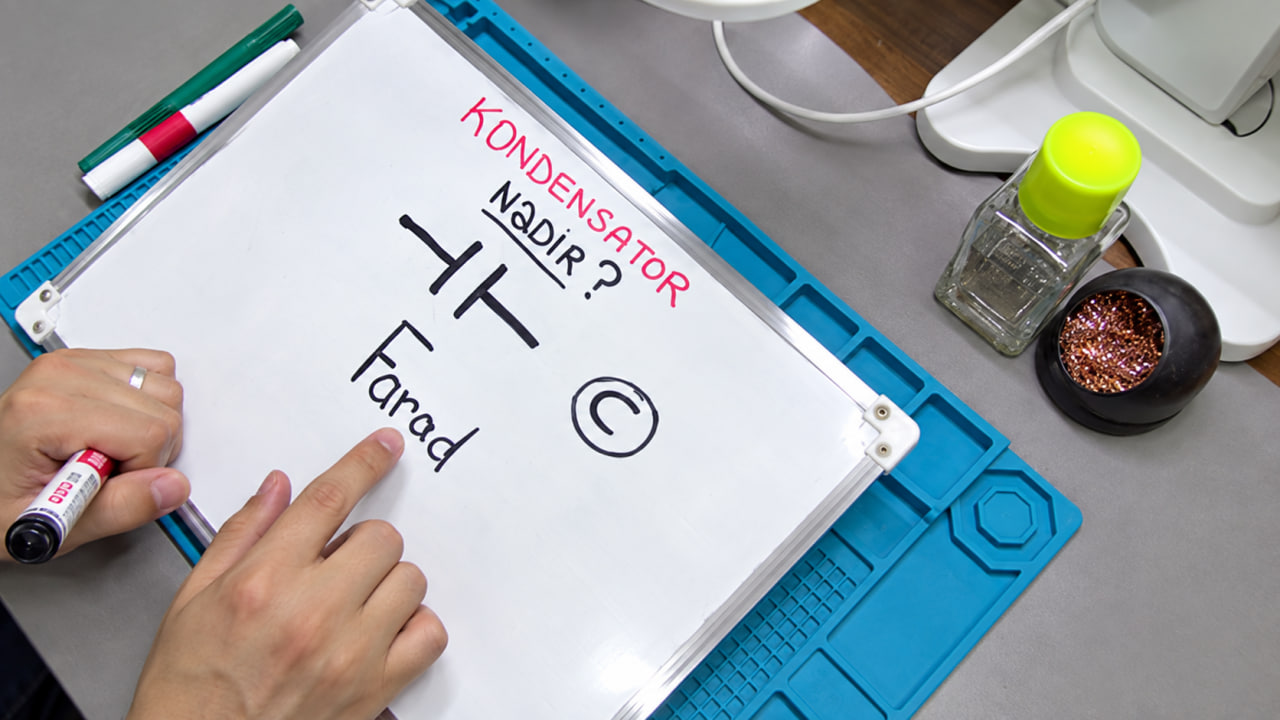
• Symbols, Labels, and Units: Understand capacitor schematic symbols, the C reference designator used on boards and schematics, and capacitance units: farad (F), microfarad (µF), nanofarad (nF), and picofarad (pF).
• Polarized vs. Non-Polarized Capacitors: Learn why electrolytic and tantalum capacitors must be installed with correct positive and negative polarity, while ceramic and many film capacitors can be fitted in either direction.
• Capacitor Types: Explore electrolytic, SMD electrolytic, tantalum, ceramic, SMD ceramic, polypropylene film, polyester film, and variable capacitors, along with their common uses in laptop boards, desktop motherboards, adapters, power supplies, and RF circuits.
• Markings and Ratings: Learn to read capacitance markings, voltage ratings, and common capacitor codes such as 105K. Understand why a capacitor’s voltage rating must always meet or exceed the voltage present in the circuit.
• Series and Parallel Connections: See how capacitors behave when connected in series or parallel, including how total capacitance and voltage capability change.
• Repair Considerations: Learn the key rules for capacitor replacement: use the correct capacitance whenever possible, select an equal or higher voltage rating, observe polarity, and ensure that relevant characteristics such as capacitor type and other electrical ratings are suitable for the circuit.
This foundation is essential for diagnosing power-rail instability, filtering problems, short circuits, and failed capacitors on laptop motherboards and power adapters.
• Basic Operation: Learn how a capacitor stores charge using two conductive plates separated by an insulating material called a dielectric, then releases its stored energy into the circuit during discharge.
• Symbols, Labels, and Units: Understand capacitor schematic symbols, the C reference designator used on boards and schematics, and capacitance units: farad (F), microfarad (µF), nanofarad (nF), and picofarad (pF).
• Polarized vs. Non-Polarized Capacitors: Learn why electrolytic and tantalum capacitors must be installed with correct positive and negative polarity, while ceramic and many film capacitors can be fitted in either direction.
• Capacitor Types: Explore electrolytic, SMD electrolytic, tantalum, ceramic, SMD ceramic, polypropylene film, polyester film, and variable capacitors, along with their common uses in laptop boards, desktop motherboards, adapters, power supplies, and RF circuits.
• Markings and Ratings: Learn to read capacitance markings, voltage ratings, and common capacitor codes such as 105K. Understand why a capacitor’s voltage rating must always meet or exceed the voltage present in the circuit.
• Series and Parallel Connections: See how capacitors behave when connected in series or parallel, including how total capacitance and voltage capability change.
• Repair Considerations: Learn the key rules for capacitor replacement: use the correct capacitance whenever possible, select an equal or higher voltage rating, observe polarity, and ensure that relevant characteristics such as capacitor type and other electrical ratings are suitable for the circuit.
This foundation is essential for diagnosing power-rail instability, filtering problems, short circuits, and failed capacitors on laptop motherboards and power adapters.