
LESSON DESCRIPTION
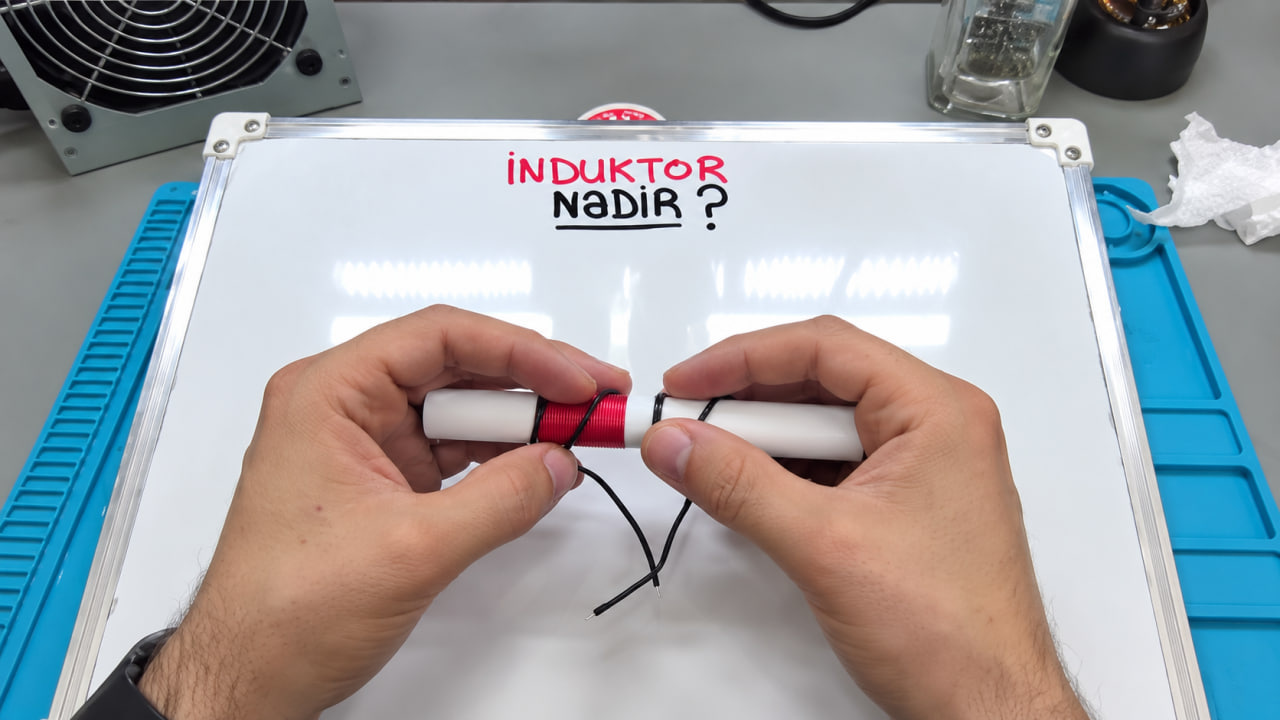
This video introduces the inductor (coil) which is a two-terminal component that stores energy in a magnetic field when current flows through its winding.
• Core Principles: Learn how copper wire wound into a coil produces a magnetic field, why inductors oppose changes in current, and how stored energy is released when current is interrupted, creating a reverse-polarity voltage spike (back EMF).
• Circuit Identification and Units: Understand inductor symbols, non-polarity, board designators such as L1 and L1001, and inductance units: henry (H), millihenry (mH), and microhenry (µH).
• Types and Construction: Explore air-core, ferrite-core, iron-core, toroidal, axial, through-hole, SMD, and variable inductors. Learn how core material, coil turns, wire thickness, and winding geometry affect inductance.
• Practical Applications: See how inductors are used for filtering, noise and EMI suppression, ferrite beads, switching/PWM power supplies, and laptop motherboard voltage-regulation circuits.
• Electromagnetic Devices: Understand the shared operating principles behind inductors, transformers, relays, motors, fans, and speakers—including transformer isolation and relay coil switching.
• Hands-On Demonstration: Observe how an inductor keeps current flowing briefly after power is removed, allowing stored magnetic energy to light a reverse-connected LED for a moment.
• Core Principles: Learn how copper wire wound into a coil produces a magnetic field, why inductors oppose changes in current, and how stored energy is released when current is interrupted, creating a reverse-polarity voltage spike (back EMF).
• Circuit Identification and Units: Understand inductor symbols, non-polarity, board designators such as L1 and L1001, and inductance units: henry (H), millihenry (mH), and microhenry (µH).
• Types and Construction: Explore air-core, ferrite-core, iron-core, toroidal, axial, through-hole, SMD, and variable inductors. Learn how core material, coil turns, wire thickness, and winding geometry affect inductance.
• Practical Applications: See how inductors are used for filtering, noise and EMI suppression, ferrite beads, switching/PWM power supplies, and laptop motherboard voltage-regulation circuits.
• Electromagnetic Devices: Understand the shared operating principles behind inductors, transformers, relays, motors, fans, and speakers—including transformer isolation and relay coil switching.
• Hands-On Demonstration: Observe how an inductor keeps current flowing briefly after power is removed, allowing stored magnetic energy to light a reverse-connected LED for a moment.