
LESSON DESCRIPTION
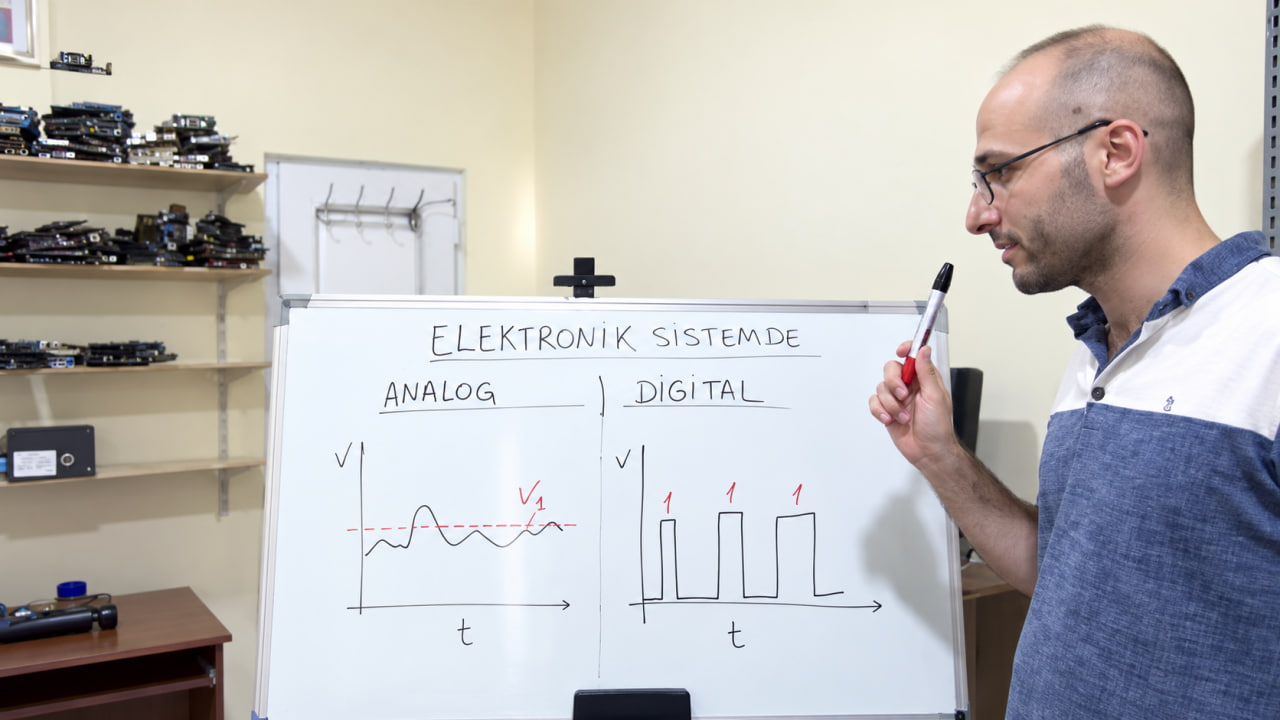
This video introduces the two main categories of electronic systems—analog and digital—and explains how their signals behave over time.
• Analog systems: Learn how analog signals vary continuously in voltage, such as the adjustable level produced by a potentiometer.
• Digital systems: Understand binary logic, where signals operate between defined Low (0) and High (1) states to represent OFF/ON or NO/YES conditions.
• Signal graphs: See how voltage-versus-time graphs are used to visualize changing analog signals and switching digital signals.
• Repair relevance: Modern laptop motherboards primarily use digital circuits. You will later identify these signals during diagnostics with an oscilloscope.
• Next concept: The video introduces PWM (Pulse-Width Modulation) signals, where the time spent at High and Low levels is important for controlling circuits.
• Analog systems: Learn how analog signals vary continuously in voltage, such as the adjustable level produced by a potentiometer.
• Digital systems: Understand binary logic, where signals operate between defined Low (0) and High (1) states to represent OFF/ON or NO/YES conditions.
• Signal graphs: See how voltage-versus-time graphs are used to visualize changing analog signals and switching digital signals.
• Repair relevance: Modern laptop motherboards primarily use digital circuits. You will later identify these signals during diagnostics with an oscilloscope.
• Next concept: The video introduces PWM (Pulse-Width Modulation) signals, where the time spent at High and Low levels is important for controlling circuits.