
LESSON DESCRIPTION
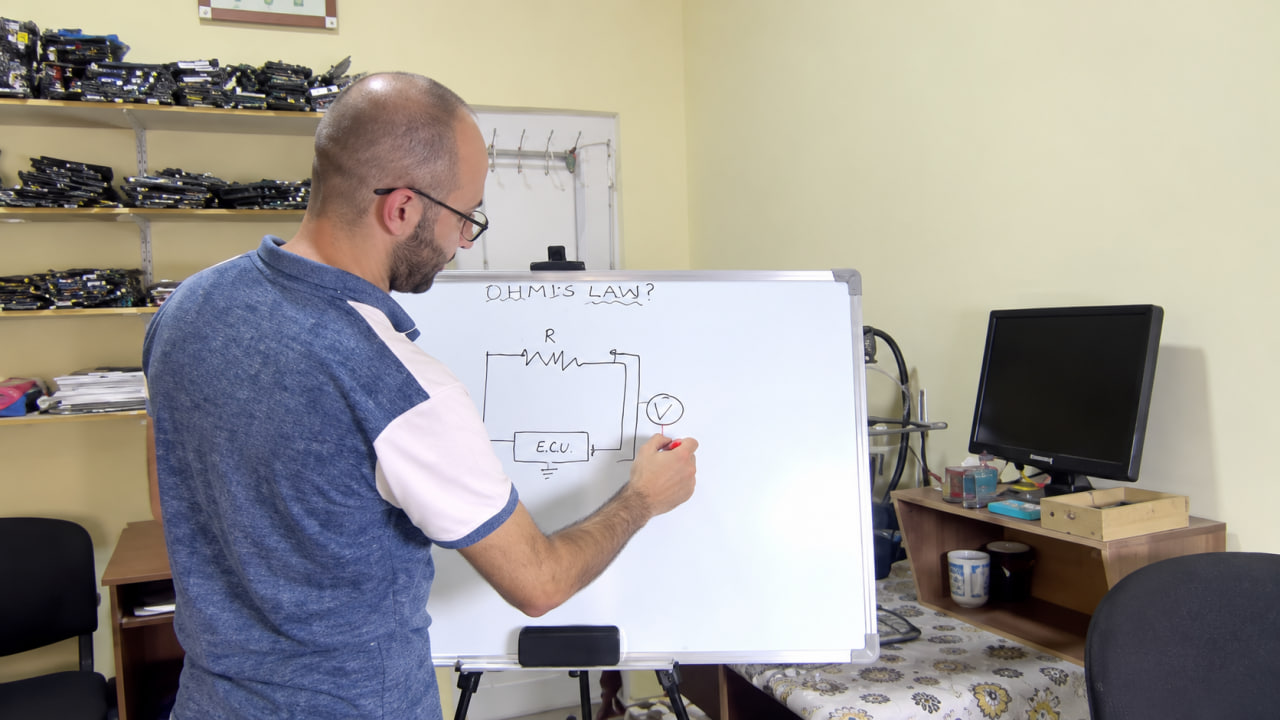
This video explains Ohm’s Law, a core principle of electronics that defines the relationship between voltage, current, and resistance in an electrical circuit.
• The Ohm’s Law formula: Learn the fundamental equation V=I×RV = I \times RV=I×R, where voltage is measured in volts, current in amperes, and resistance in ohms.
• Calculate unknown values: Use the formula triangle to determine voltage (V=I×R)(V = I \times R)(V=I×R), current (I=V÷R)(I = V \div R)(I=V÷R), or resistance (R=V÷I)(R = V \div I)(R=V÷I) when the other two values are known.
• Understand circuit behavior: See why current increases when voltage rises at a fixed resistance, and why current decreases when resistance increases at a fixed voltage.
• Practical visualization: A water-and-hose analogy makes the relationship between electrical pressure, electron flow, and resistance easier to understand.
• Repair relevance: Ohm’s Law provides essential groundwork for interpreting measurements, troubleshooting circuits, and later adapter and motherboard repair videos.
• The Ohm’s Law formula: Learn the fundamental equation V=I×RV = I \times RV=I×R, where voltage is measured in volts, current in amperes, and resistance in ohms.
• Calculate unknown values: Use the formula triangle to determine voltage (V=I×R)(V = I \times R)(V=I×R), current (I=V÷R)(I = V \div R)(I=V÷R), or resistance (R=V÷I)(R = V \div I)(R=V÷I) when the other two values are known.
• Understand circuit behavior: See why current increases when voltage rises at a fixed resistance, and why current decreases when resistance increases at a fixed voltage.
• Practical visualization: A water-and-hose analogy makes the relationship between electrical pressure, electron flow, and resistance easier to understand.
• Repair relevance: Ohm’s Law provides essential groundwork for interpreting measurements, troubleshooting circuits, and later adapter and motherboard repair videos.